
What 144 Million YouTube Channels Reveal About the Creator Economy in 2026
By Nisa @June, 17 2026

Most analysis of YouTube starts from the wrong number.
YouTube is not a platform overflowing with active creators. It is a platform dominated by silence, concentrated at the top, and entering a phase of structural maturity that most of the industry hasn't fully reckoned with.
This is what WebAutomation's proprietary dataset, built from one of the world's largest YouTube channel databases, actually shows. The full report is available here.

The Ghost Town Inside the World's Biggest Video Platform
Start with the number that should reframe every conversation about YouTube's scale: 48 million channels have never uploaded a single video.

Go further. Only 42.7% of active channels uploaded something in the last 30 days. Even extending the window to a full year, barely half the platform (49.4%) shows any sign of creative life. The three-year active figure climbs to 57%, but that still means more than 40% of YouTube's supposedly "active" base hasn't been published in over three years.
For anyone buying or licensing YouTube data, the difference between a raw channel list and a verified active-creator dataset isn't cosmetic. It determines whether your downstream analysis reflects the actual market or an inflated fiction.
The Creator Pyramid Is Even Steeper Than You Think
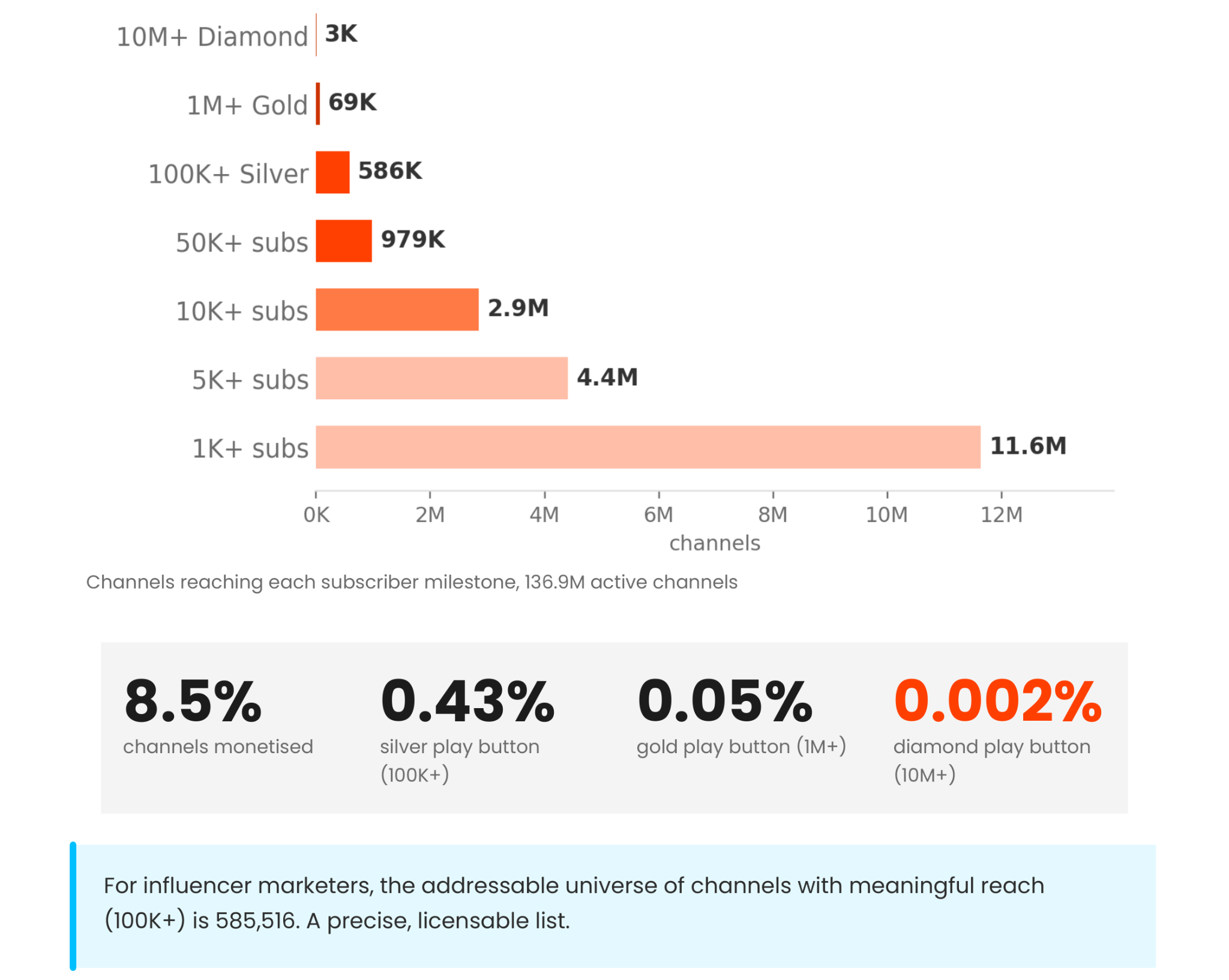
Put that last number in context: for every single Diamond-tier creator, there are nearly 47,000 channels that never reached 1,000 subscribers. The long tail of YouTube is not a secondary feature of the platform. In terms of channel volume, it is the platform.
For anyone building influencer marketing strategies, these figures define the actual universe. The 585,516 channels with 100K or more subscribers represent a large absolute number, but a precise and licensable one. The broader claim that YouTube offers limitless influencer inventory is only true if you are willing to work in the nano tier, where audience engagement can be high but reach is strictly limited and consistency is impossible to guarantee.
The concentration at the top also has implications for brand safety and campaign reliability. Those 2,915 Diamond channels almost certainly account for a disproportionate share of total platform views. Any media strategy that isn't reaching into that top fraction is competing for the long tail's fragmented and unpredictable attention.
YouTube Is Not an American Platform. The Industry Hasn't Caught Up.
When Western marketers and agencies discuss YouTube strategy, they typically mean English-language content optimised for US audiences. The data suggests this framing is structurally obsolete.
Of the 26 million channels where creators have voluntarily set a country, the United States leads with 20.6%. That sounds dominant until you examine the full distribution. India accounts for 9.3%, Brazil for 7.2%, and Indonesia for 5%. Together, those three countries rival the US in channel count. Russia, Japan, Germany, and France each clear 700,000 channels.

Critically, 81% of all channels have no country set at all. The 26 million geotagged channels are a minority of the dataset. The true geographic distribution, once unknown channels are accounted for, almost certainly skews even further toward South and Southeast Asia, Latin America, and other non-English-speaking markets. Four of the top five countries by channel count are non-English-first markets, and 220 or more countries are represented across the full dataset.
The implication is direct: any product, dataset, or intelligence tool that analyses YouTube from an English-language or US-centric perspective is working from a fundamentally incomplete view of the market. A content trend that appears niche from an American lens may be dominant in Indonesia or Brazil. A channel that looks small by global subscriber standards may be the leading voice in a regional market with significant commercial value.
The globalisation of content creation is not coming. It has already happened. It just isn't evenly reflected in how most of the industry talks about the platform.
The Pandemic Surge Created 11.4 Million Channels in a Year. Then It Ended.
The most clarifying finding in the temporal data is one that should reshape how the whole industry frames platform trajectory.
Then it reversed. New channel creation fell every year after the peak: from 11.4 million in 2020 to 1.4 million in 2024, and just 927,000 in the partial data available for 2025. That represents an 88% decline from peak to 2024. The trajectory has not reversed.
This is not the collapse of a platform. YouTube's 94.7% channel retention rate is remarkably low for a platform of this scale, and the view counts are genuinely civilisation-scale. But it is the end of something specific: the era of exponential new-creator growth.
For market researchers and investors, the distinction matters. A platform in growth mode and a platform in maturity mode require different analytical frameworks. In growth, new entrants drive disruption, attention is redistributed, and audience habits are still forming. In maturity, competition for attention happens within an established pool. Discovery of new creators becomes harder, and incumbent channels with existing audiences compound their advantage over time.
The 53.5 million channels created between 2016 and 2020 form the structural backbone of today's creator ecosystem. Future growth will come from within that existing pool, not from a new wave of entrants. For brands and agencies building long-term creator partnerships, this has a direct consequence: the window to establish relationships with rising creators before they become expensive is narrowing. The platform is mature enough that the shape of the channel landscape in 2026 will look reasonably similar in 2028.

What the Data Means for People Who Use It
The findings above carry different weight depending on where you sit.
For brands running creator partnerships, the geographic data should prompt a genuine audit of whether your current strategy reflects where YouTube's creator base actually sits. An influencer roster that skews overwhelmingly American may be overpaying for reach in a saturated market while leaving significant opportunity unaddressed in high-growth regions where comparable budgets go much further.
For data professionals and researchers, any dataset that uses raw channel counts as a proxy for market activity is, by definition, misleading. Active creator counts filtered for upload recency are roughly half the size of the raw active channel figure. For machine learning applications, competitive intelligence models, or market sizing work, that distinction is not trivial.
The Number Behind Every YouTube Conversation
205 trillion views. If every person on Earth watched YouTube continuously, it would take 26,000 years to consume every video ever uploaded to the platform.
That is a real number, and it represents something genuine: YouTube's status as one of the most consequential publishing platforms in human history. The average channel in our dataset is over a decade old. The platform's churn is low. Its reach is genuinely planetary.
But the shape of that platform is routinely misread. 144 million channels do not mean 144 million active creators. 473 billion subscribers do not mean 473 billion engaged audiences. The platform is older, more concentrated, more international, and more top-heavy than most of the content and marketing industry acknowledges.
Understanding the creator economy in 2026 means holding both truths at once.
This analysis is based on WebAutomation's proprietary YouTube channel dataset, covering 144.7 million channels with data collected in May 2026 from public pages. The full dataset is available for licensing, API access, and custom slices. Contact WebAutomation to get started.
RECENT POSTS
RELATED POSTS
CATEGORIES
follow us on



 Linkedin